








If you’re building a big-block Chevy, whether for street, strip, or classic restoration, the exhaust header flange is more than just a connection point. It’s the foundation of your exhaust system’s durability, flow, and thermal performance.
The Khaos Motorsports 304-grade stainless header flange offers unmatched corrosion resistance, heat tolerance, and precise fitment for heavy-duty and high-performance Chevy V8 builds.
When you’re chasing serious power, you don’t want a weak link, and this flange is designed to last as long as your engine does.
Why Stainless Flanges Matter, Material Matters
304 Stainless Steel vs Mild Steel
Stainless steel (especially 304 grade) significantly outperforms mild or standard carbon steel when it comes to exhaust applications. It resists rust and corrosion, holds up under high temperatures, and retains structural integrity under thermal cycling. Dragzine+1
Mild steel may work initially, but over time, exposure to heat, moisture, salt, and exhaust gases can eat away at its integrity. For long-term builds, stainless is widely considered “buy it once, keep it forever.” JEGS+1
Durability Under Heat & Exhaust Stress
304 stainless has a lower thermal conductivity than mild steel, which helps keep more heat energy inside the exhaust gases, preserving exhaust velocity and improving scavenging. Dragzine+1
This means: less heat radiated into the engine bay, better scavenging, more consistent output and lower risk of header warping or flange cracking over time.
What the Khaos Header Flange Offers
-
Material: 304 stainless steel, corrosion- and heat-resistant, built for heavy-duty V8 builds
-
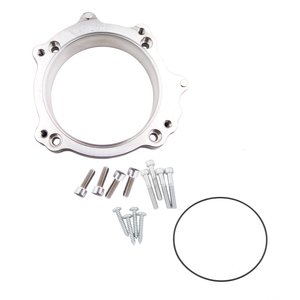
Specs: 3/8" thick (0.375) flange, 2-1/4" port spacing (or whatever the listed spec is) built for Big-Block Chevy exhaust ports
-
Precision fitment: Flat-machined flange surfaces for leak-free sealing and correct header-to-head alignment
-
Long-term reliability: Stainless resists rusting, corrosion, and metal fatigue, ideal for high-heat, high-exhaust-volume engines
Because exhaust headers are only as good as the flange sealing the ports, this 304 stainless flange makes sure you get all the benefits of smooth flow and long-lasting durability.
Stock Manifold/Flange vs. Performance Stainless Flange
| Feature | Stock/Cast Manifold or Mild-Steel Flange | Khaos 304 Stainless Flange |
|---|---|---|
| Corrosion Resistance | Prone to rust / corrosion over time | Highly corrosion-resistant, longer lifespan Dragzine+1 |
| Heat Management | Absorbs and radiates heat, more heat soak | Retains exhaust heat, reduces under-hood heat, improves scavenging Dragzine+1 |
| Structural Stability | Risk of warping, cracking under stress | High strength + fatigue resistance, stable under load Banks Power+1 |
| Exhaust Flow Support | Often restrictive or inefficient | Allows full benefit of performance headers, optimized flow and sealing |
| Longevity | Moderate to low (depending on environment) | High, often outlasts the engine when maintained properly |
When This Upgrade Makes the Most Sense
If you’re doing any of the following, this flange should be high on your parts list:
-
Big-block Chevy build (street, strip, restoration, or hot-rod)
-
Running aftermarket headers, long-tubes, or performance exhaust
-
Operating in salty/challenging climates (rust resistance matters)
-
Planning for longevity and avoiding repeated exhaust rebuilds
-
Looking for leak-free sealing, consistent exhaust flow, and better thermal/flow performance
In short, if you want reliability, performance, and durability all wrapped into one simple hardware upgrade.
Installation & Build Tips
-
Ensure surface flatness: Clean and prep the cylinder head flanges before mounting to avoid leaks.
-
Use proper exhaust gaskets and high-temp sealants: Stainless tolerates heat, but sealing surfaces need good gaskets.
-
Match tube/wrap choices: If using long-tubes or turbo headers, consider heat wrap or ceramic coating to harness the thermal advantage of stainless.
-
Torque in sequence and re-check: Stainless can expand/contract differently, retorque after first heat cycle.
-
Combine with full stainless system: From headers to mid-pipe to tail – full stainless yields the best longevity and performance gains.
FAQ
Why 304 stainless and not mild steel?
304 stainless resists rust and corrosion, handles high exhaust temperatures, and is far more durable over the long haul, ideal for exhaust components. Dragzine+1
Will this flange improve horsepower by itself?
Not directly, but it enables the full potential of performance headers by providing proper flow, sealing, and durability. Combined with tuned headers and exhaust, flow gains translate to better scavenging and possible power/torque gains. Holley+1
Is this flange overkill for a stock rebuild or mild build?
If you want longevity, rust resistance, and quiet reliability, even a mild build benefits from stainless. It’s a “buy once” upgrade compared to repeated mild-steel replacements.
Does stainless make exhaust heat worse under hood?
Actually, stainless retains more heat inside the exhaust gases, meaning less radiant heat to the engine bay, which helps protect sensitive components. Dragzine+1
Is installation complicated?
No more complicated than standard header installation, just ensure proper gasket & torque specs, and inspect for sealing.